Unveiling LGBTQ+ History: Five Engaging Lessons for DC Students
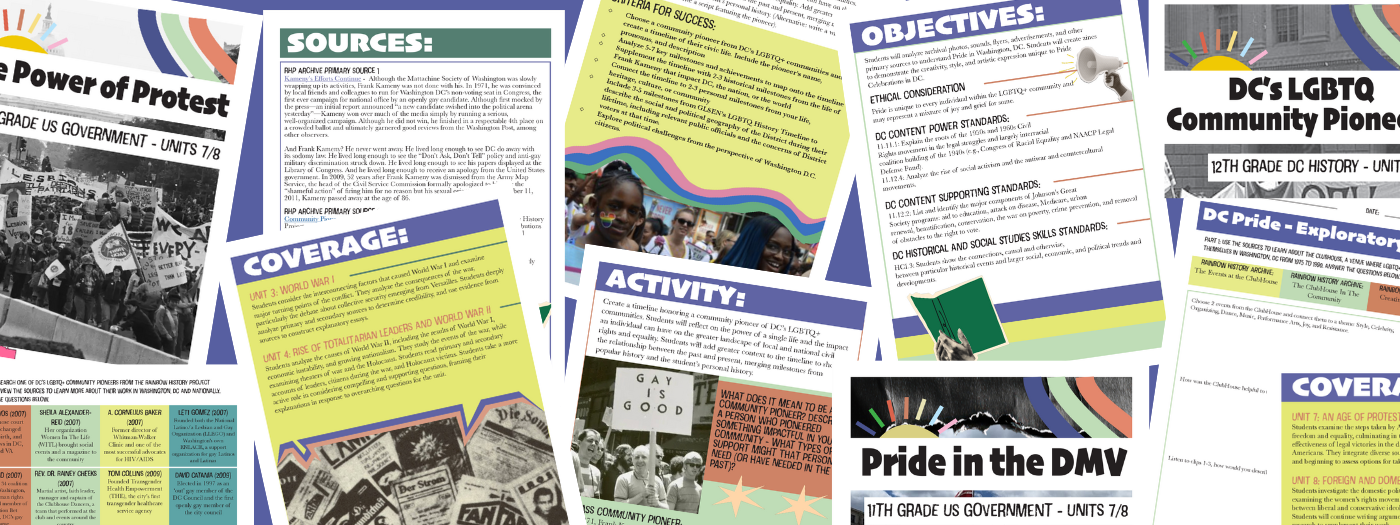
In 2023, the DC State Board of Education adopted a new set of social studies standards that elevates the inclusion of the local, national, and global LGBTQ+ community history. There are nine standards that specifically ask educators to teach lessons on DC’s historically marginalized groups; including LGBTQ+ people. “Unveiling LGBTQ+ History: Five Engaging Lessons for DC Students” is DC’s first Common Core and DC Social Studies standards-aligned lessons focused on LGBTQ+ history to provide support for DC’s K-12 educators as they immerse their students in the history of the city around them. The nine standards that include LGBTQ+ history focus on teaching collective action, community building, political movements, personal experiences, civic engagement, and self-determination. The curriculum underwent a series of feedback loops where the consultant and Rainbow History Project held discussions with DC Public School principals & teachers, parents, and community organizations to determine effectiveness.
All lessons include:
- outline,
- standards,
- lesson plan,
- vocabulary, and
- student worksheets.
The lessons will have the flexibility for different grade and ability levels, so educators have various options for identifying the most appropriate resources. Each lesson will aim to take 75 to 90 minutes and can be broken up and taught throughout the school year. The curriculum has a workbook with links to archival documents within the Rainbow History Project’s collections. The curriculum is free to use for educators both digitally and printed.
While the lessons highlight opportunities for students to delve deeply into DC’s LGBTQ+ histories, educators may find that honing in on their school’s community as a microcosm achieves similar objectives and enforces the importance of teaching about collective action, community building, political movements, personal experiences, civic engagement, and self-determination.
Explore & Share the Curriculum
Interested in bringing the history of DC’s LGBTQ+ communities to your school? Read more below!
Educators
Educators have the right to teach in a discrimination-free workplace. Communicate with school leadership for support in implementing this curriculum.
– Lessons are Common Core and DC Social Studies standards-aligned.
– Nine standards that specifically ask educators to teach lessons on DC’s historically marginalized groups; including LGBTQ+ people.
– Lessons enforce the importance of teaching about collective action, community building, political movements, personal experiences, civic engagement, and self-determination.
Students
Students have the right to learn in a discrimination-free school. Communicate with your social studies teacher, school leadership, and the Student Advisory Committee of the State Board to bring this lesson to your school.
– As a student in DCPS, I live in a city that supports diversity and the right to education for every child.
– DC Social Studies standards allow me to learn about people from different backgrounds and experiences.
– DCPS is committed to removing barriers to academic and social success.
Parents & Caregivers
Parents have the right to be in a discrimination-free community. Communicate with your student’s social studies teacher, school leadership, parent-teacher organizations, and the State Board to bring this lesson to your school.
– The State Board of Education ensures that every student is valued and learns the skills and knowledge necessary to become informed, competent, and contributing global citizens.
– In 2026, the State Board of Education aims to strengthen physical and psychological safety for all students by identifying key drivers of harm and partnering with experts, community voices, and education leaders to promote well-being before, during, and after the school day.
Wearable Resistance
8th Grade Action Civics, 9-12 Social Studies
Students will identify symbols, words, and design choices in historical ephemera and analyze how protest messages are made visible or hidden. Students will sort and interpret ephemera based on tone, symbolism, and intended audience, then reflect on protest as both survival and resistance, especially in health justice movements
The War at Home
10th Grade US History, Units 3-4
Students will use multiple archival sources to write a personal narrative that connects their lives to the life experiences of Henry Gerber, a veteran from Chicago who was arrested for his LGBTQ+ rights protests in Washington, DC.
The Power of Protest
11th Grade US Government, Units 7-8
Students will analyze archival sources to learn more about the removal of LGBTQ+ government workers during the Lavender Scare and the subsequent organizing of two DC LGBTQ+ organizations. Students will complete a graphic organizer about the key political leaders and themes, relating them to the coalitions and protests of the Lavender Scare.
DC Pride
11th Grade US Government, Units 7-8
Students will analyze archival photos, sounds, flyers, advertisements, and other primary sources to understand Pride in Washington, DC. Students will create zines to demonstrate the creativity, style, and artistic expression unique to Pride Celebrations in DC.
DC’s LGBTQ Community Pioneers
12th Grade DC History, Units 3-4
Students will analyze archival sources to create a timeline honoring a community pioneer of DC’s LGBTQ+ communities. Students will reflect on the power of a single life and the impact an individual can have on the greater landscape of local and national civil rights and equality. Students will add greater context to the timeline to show the relationship between the past and present, merging milestones from popular history and the student’s personal history.
FAQ
How do I use the Rainbow History Archive?
Digital: The majority of digital collections are catalogued with finding aids, making them easily accessible. Most prominent in the digital collections is RHP’s oral history archive. Many items, specifically images and photographs, were recently digitized for the exhibit, Those items are easily accessible within RHP’s Drive.
- The Archives Catalog contains records for all RHP collections, hundreds of digitized files and links to digitized recordings, including more than 350 oral histories.
- The RHP YouTube channel features digitized recordings of historical news footage, films and public events, including recordings of RHP’s public panels.
- The RHP Internet Archive channel contains primarily sound recordings (historic radio and other audio-only files) and certain films and other copyrighted recordings.
- Our Places and Spaces social geography database documents locations important to the D.C.-area LGBTQ community and includes basic data known about the location. It is a work in progress and additions from the public are always welcome.
- RHP Exhibits are online presentations of research projects. It is hosted within the Archives Catalog. We welcome new exhibitions and research projects created by anyone
Physical: Most of RHP’s collections, including documents, ephemera, photo negatives, and other materials, have yet to be digitized. These physical materials are accessible at RHP’s archiving partner, the DC History Center. To access these materials, researchers/writers must make an appointment or visit the DC History Center during open hours.
- All collections are described in the RHP Archives Catalog, including links to finding aids. Materials are also described in the DC History Center catalog in the online guide to the Rainbow History Project Collection.
- RHP maintains a Guide to Finding Aids that includes titles of archival collections, periodicals and ephemera, as well as links to finding aids and indexes of periodicals available at the DC History Center. It also includes information about recent acquisitions that have not yet been transferred or digitization projects currently underway.
- Appointments are required in order to conduct research at the Kiplinger Library. To request an appointment, email library@dchistory.org with a brief description of your research with RHP,list of requested materials, and preferences for appointments. Open Tuesday and Thursday, 10am-12pm and 1pm-3pm.
What should I do if I am an educator that needs technical support?
Educators experiencing technical issues with the Rainbow History Project archive can email info@rainbowhistoryproject.org with a description of your technical issue for assistance.
Educators are welcome to visit the DC history center and speak to the librarian for more learning and field trips. Appointments are required in order to conduct research at the Kiplinger Library. To request an appointment, email library@dchistory.org with a brief description of your research with RHP,list of requested materials, and preferences for appointments. Open Tuesday and Thursday, 10am-12pm and 1pm-3pm.
These lessons were made possible by the Mayor’s Office of Lesbian, Gay, Bisexual, Transgender and Questioning Affairs.